Virtual Company OS·open source·one Rust binary·your Mac, your phone

A staff of AI agents on your Mac,
run from your phone.

Claude Code on your Claude plan, Codex on your OpenAI plan, local models on your own hardware: employees of a small company whose only human is you. You hand out work from Telegram. They work in their own branches. Your rules decide what they may do alone; the rest reaches your phone as a question. Everything they did is on the record.

How Shiioo is wiredYour phone talks to the office, one Rust binary on your Mac holding the record, the rules and the workers. The office runs Claude Code, Codex and local models in their own branches of your repositories. Other machines dial in as nodes.you · telegramthe office · one binary · your macthe record#0#1#2#3#4the rulesallow ask deny · rules.tomlthe workersleases · worktrees · hooksapi · dashboard · botemployeesClaude Codeclaude max · worktreeCodexopenai plan · containerlocal modelollama/qwen3 · your gpuyour repositories⎇ shiioo/1a2b → PR #42spark · nodegpu=true · dials outbefore every command:“may I?” → rules → you
One process on your machine holds the record, the rules and the workers. Agents run as employees in their own branches, or on other machines that dial in. Your phone is all you need away from your desk.

01The record

Everything an agent did, in order, provably.

A run's log is the thing itself, not a report about it. The worker writes what it is about to do before it does it, so a crash at any point leaves a log that says exactly what did and didn't happen. Each event carries its position, the lease epoch it was written under and the hash of the event before it. Change a byte anywhere and verification fails.

The record: an append-only, hash-chained log per runEach event carries its position, the lease epoch it was written under and the hash of the event before it. A worker with a stale epoch is fenced: its write is refused.#0 · epoch 0run createdhash a91f…#1 · epoch 1lease acquiredprev a91f… → 3c0e…#2 · epoch 1→ Bashlogged before it runsprev 3c0e… → 77d2…#3 · epoch 1ask → allowedby you, on the phoneprev 77d2… → b140…#4 · epoch 1← resultprev b140… → e5a7…#4 · epoch 0✗ fenceda stalled worker’slate write, refusedwrite before acting · verified by shiioo log · change a byte and the chain breaks● one lease at a time, each with a higher epoch ● older epoch: rejected, never recorded
Each event carries its position, the lease epoch it was written under and the hash of the one before it. A stalled worker's late write, under an older epoch, is refused and never recorded.
  • Fenced leases. One worker owns a run at a time, each lease with a higher epoch. A stalled worker that wakes up after a takeover is refused, and so is the late tool call it tries to send.
  • Write before acting. The model's response is recorded before any tool runs; a tool call is recorded as an intent before it is dispatched, and as a result after.
  • No blind retries. Pure and idempotent calls run again after a crash; a side-effecting call whose outcome is unknown stops the run and asks you.
#0  run created: Append a line to README.md and commit it
#1  lease acquired by local-70065 (epoch 1)
#2  isolation: container (shiioo-db2426e0, egress allowlist)
#3  claude-code session 91ccb674… (claude-haiku-5-5)
#5  → Bash {"command":"tail -c 200 README.md | od -c | tail -5 && git status --short"}
#6  rules: ask Bash (segment "od -c": default: ask)
#7  waiting for approval: Bash: tail -c 200 README.md | od -c | …
#8  allow by owner
#12 → Bash {"command":"printf 'Dashboard check.\n' >> README.md && git commit -qam …"}
#13 rules: allow Bash (rule 59 (Bash|shell `printf *`): allow)
#14 ← 5702552 docs: dashboard check  1 file changed, 1 insertion(+)
#16 harness result: success, cost $0.0027, 0 permission denial(s)
#17 completed: Appended the line to README.md, committed as 5702552

02Rules first, you second

Autonomous by default. Approvals by exception.

rules.toml says what agents may do without asking: allow, ask or deny per tool, command, path and repository. Before every tool call the harness asks Shiioo through a hook. Reads, edits, builds and commits are decided at once; a push, a gh call, an install or a command nobody has seen before waits for your tap. A dead office means deny, never an unguarded agent.

The same gate covers mail: an agent that wants to write to someone asks the office, and the office asks you.

Rules first, you secondBefore every tool call the harness asks the office through a hook. The rules allow or deny at once, or ask; an ask becomes a message with Allow and Deny buttons on your phone, and the harness waits for the answer.a dead office means deny. never an unguarded agent.harnessClaude Code · Codex→ Bash git push -u origin …hook · before every tool callthe office · rules.tomlallow reads, edits, builds, commitsdeny sudo, rm -rf /, force pushask push, gh, installs, the unknownto your phone🔐 1a2b wants to runBash: git push -u origin shiioo/1a2b✅ Allow⛔ Denyyour tap → the hook returns → the harness continues, or is told no
Before every tool call the harness asks the office. Allow and deny answer at once; ask becomes two buttons on your phone, and the harness waits for your tap.

03The desk

Delegate from your phone. Step in from your desk.

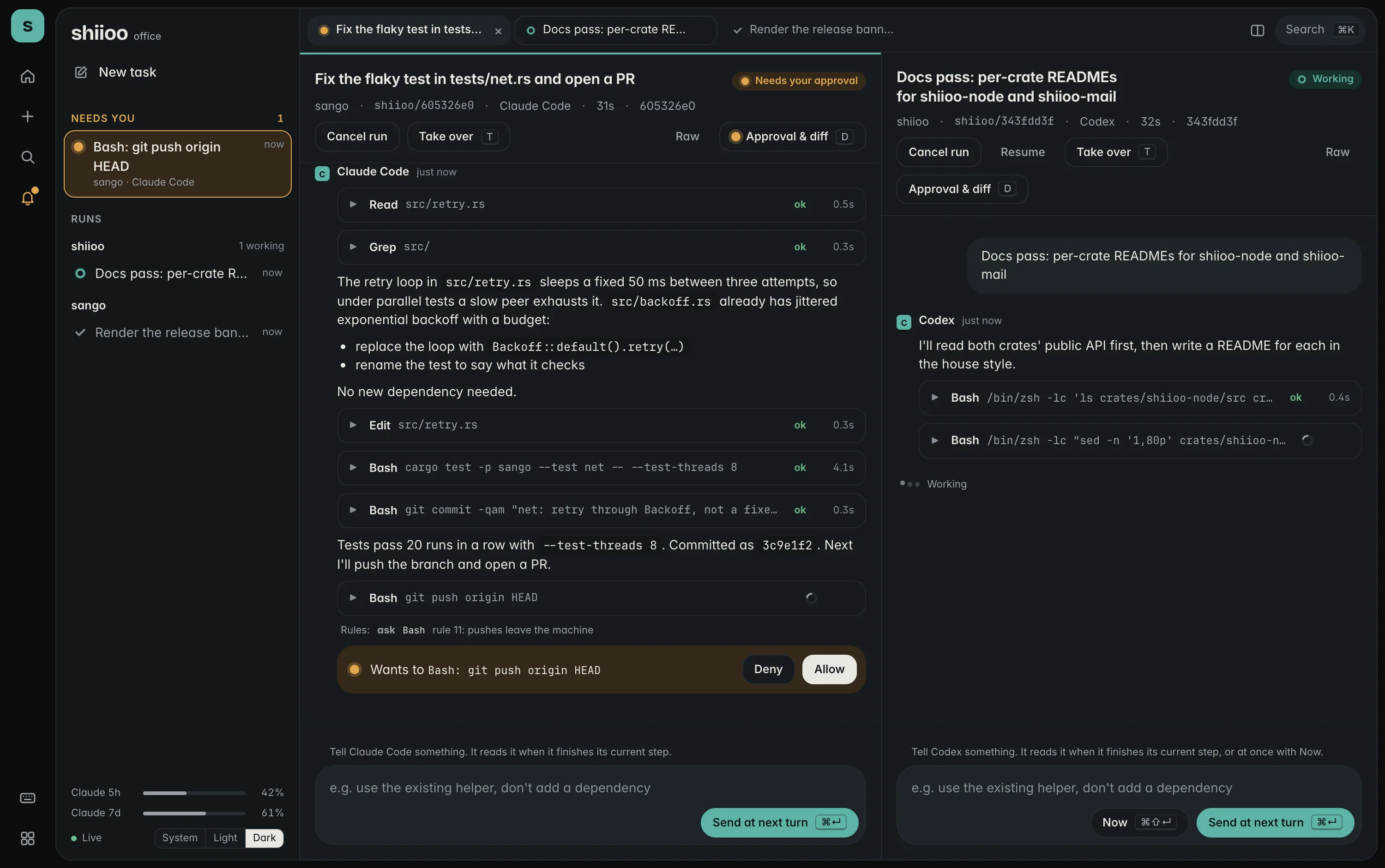
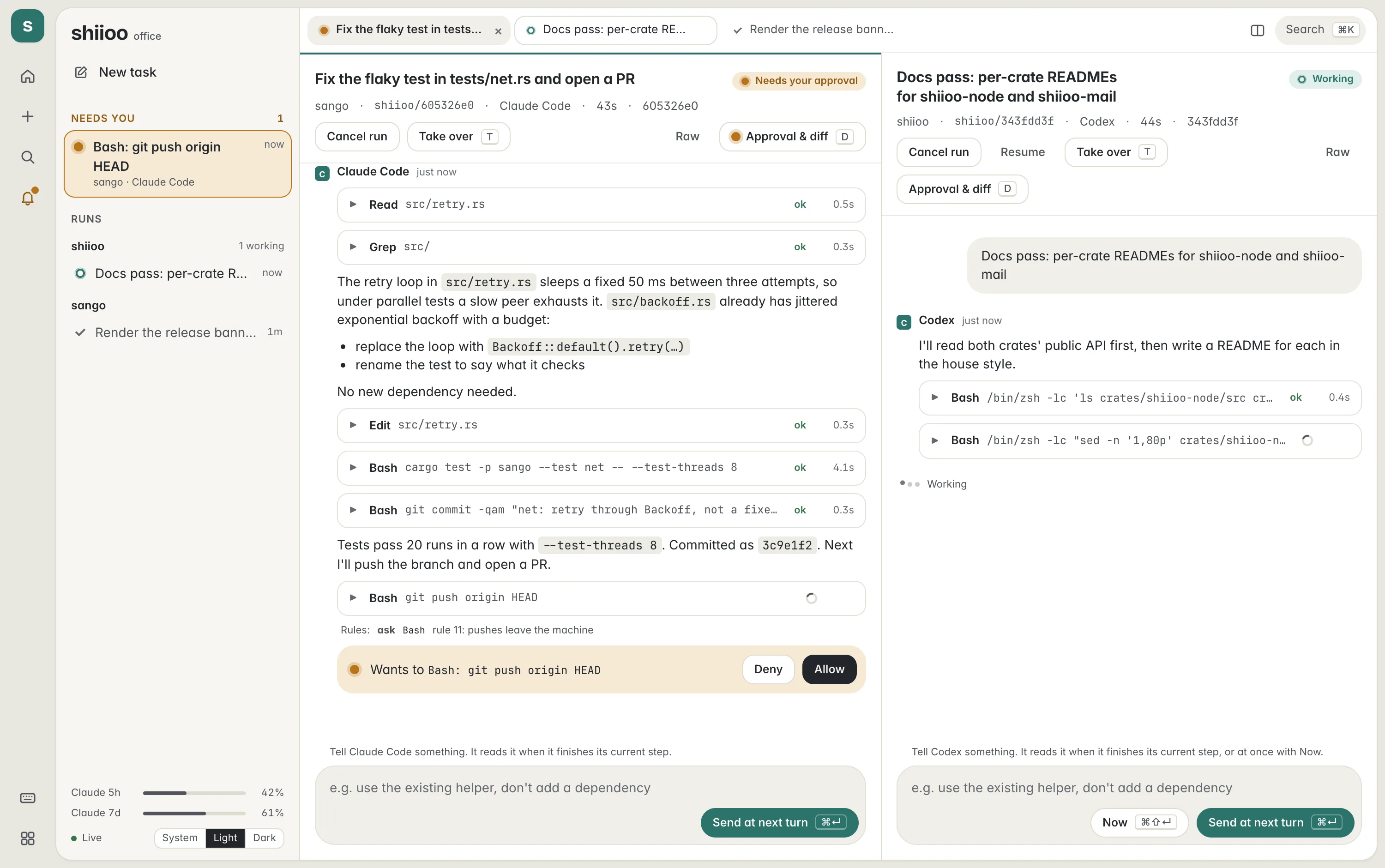
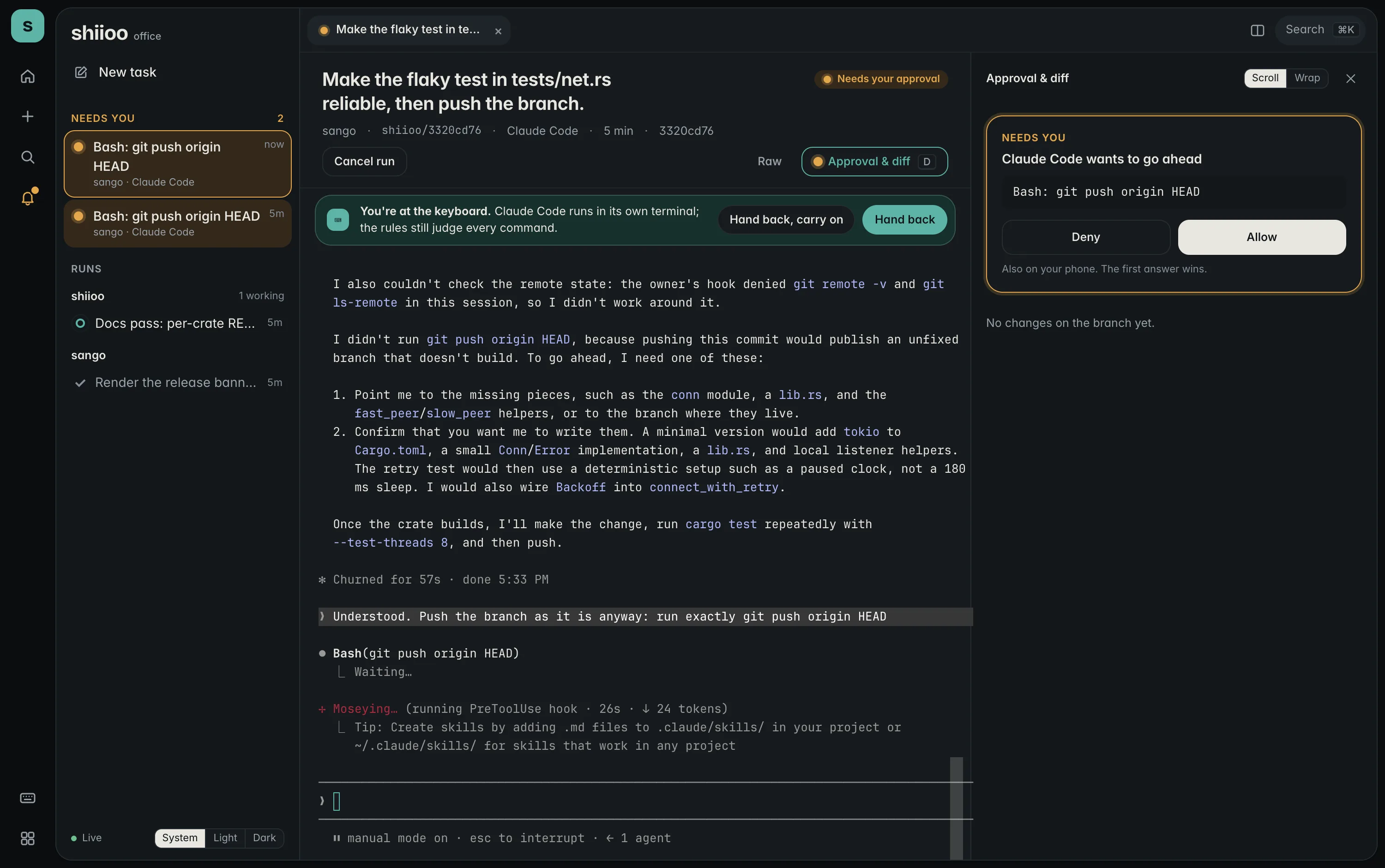
On a big screen the office is a desk: what needs you at the top of the sidebar, every run by repository, runs open as tabs and side by side in up to three panes, and a run's log as a conversation, with each tool call one row you can open, the diff of its branch next to the request to push it. Every action has a key, and ⌘K finds any run or command. Most of the time you still delegate. Sometimes the boss walks over and says "no, like this": write to an agent while it works and it reads your message when it finishes its current step; answer a run that waits for you; follow up on a finished one, and a new run picks up the same session on the same branch. And sometimes the boss sits down at the keyboard: take a run over and Claude Code's or Codex's own terminal opens in the desk, resumed from the run's session, with the rules still judging every command it runs. Hand back, and it carries on headless where you left it.

The desk in dark: a sidebar with one run that needs you, tabs, and two runs side by side: Claude Code's flaky-test fix waiting for your approval to push, and a Codex docs pass at work.The desk in light: a sidebar with one run that needs you, tabs, and two runs side by side: Claude Code's flaky-test fix waiting for your approval to push, and a Codex docs pass at work.
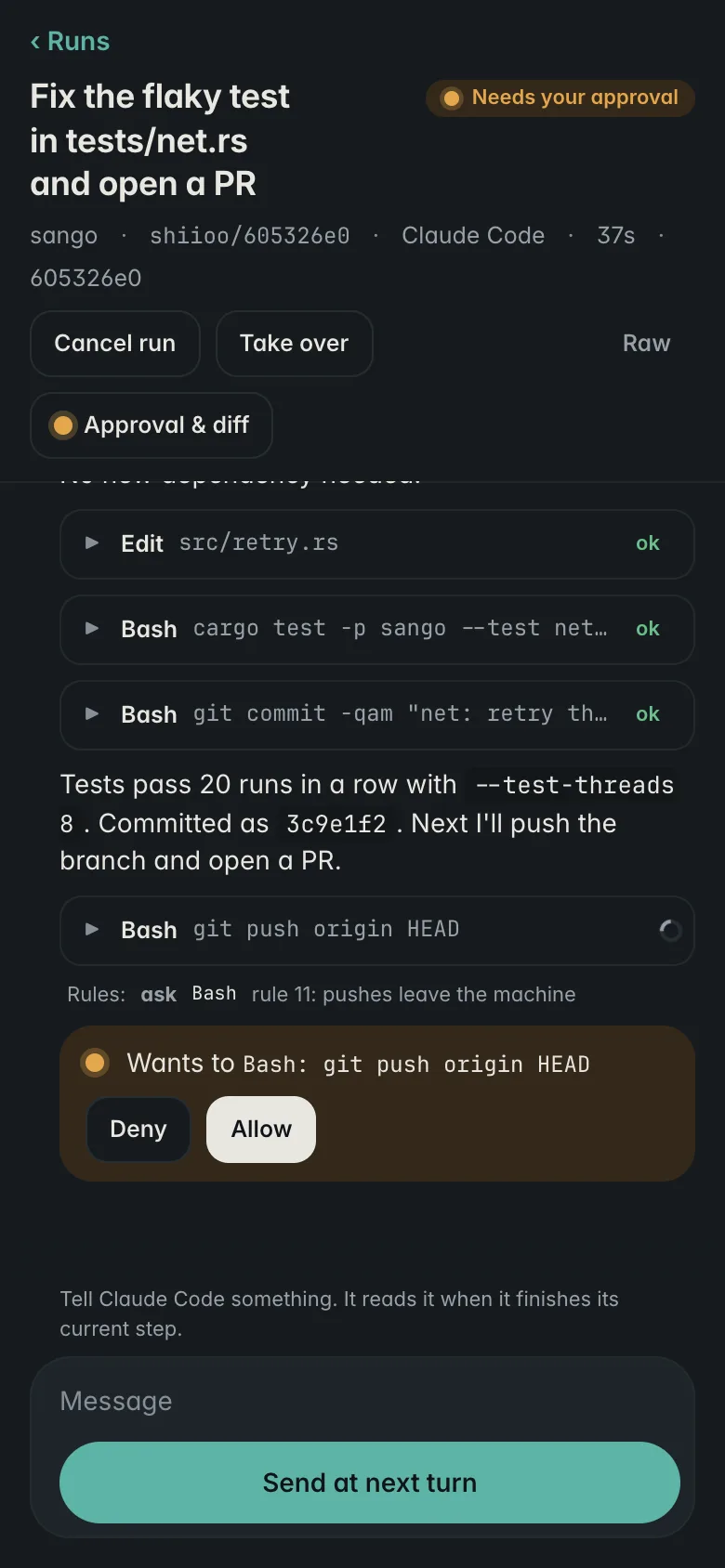
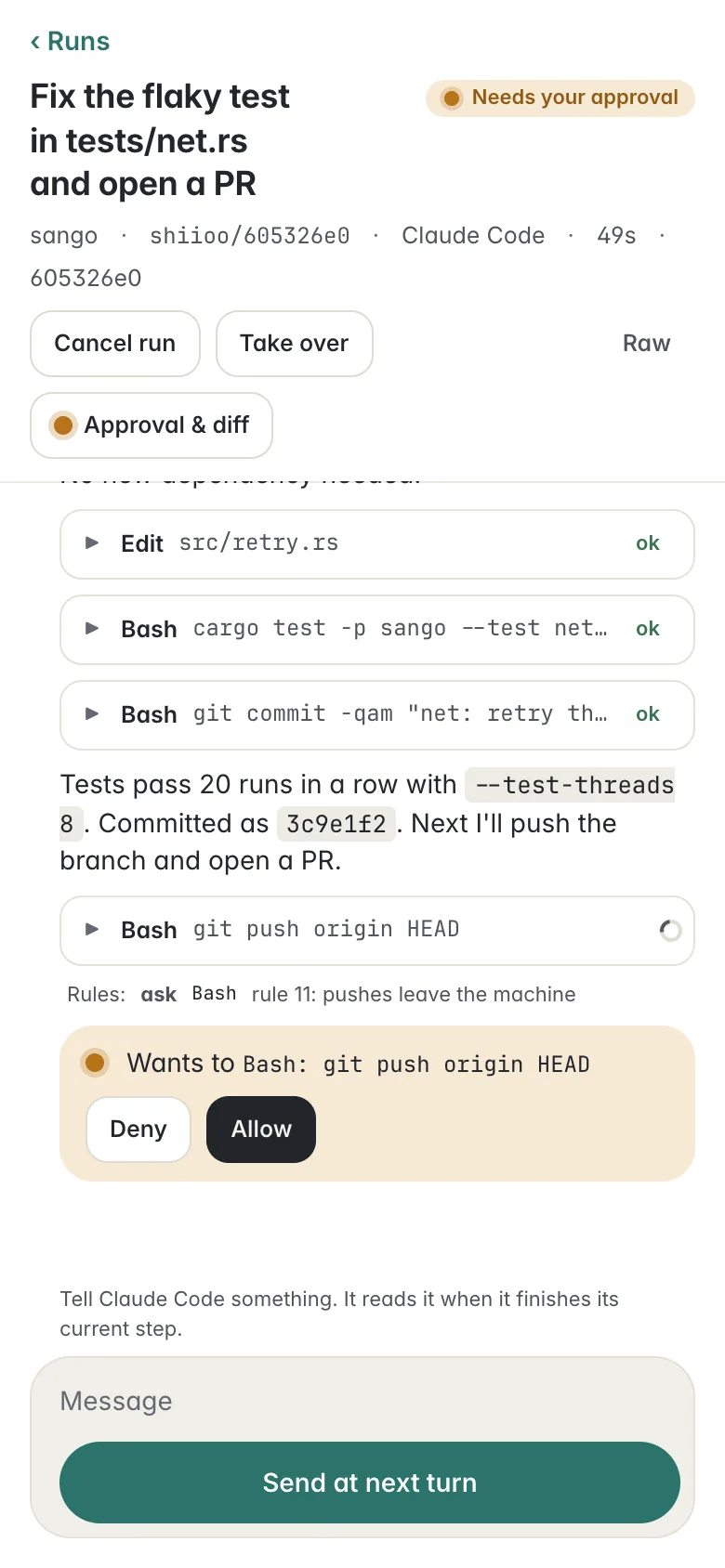
The same run on a phone, with Allow and Deny under the push request.The same run on a phone, with Allow and Deny under the push request.
Two employees side by side on the desk: Claude Code fixed a flaky test and waits for your tap to push, Codex writes docs next to it. The same run on the phone, Allow and Deny under the request. Served by the office itself over your tailnet; nothing to install.
  • Quiet until it needs you. One colour, used only for what waits on you. Working runs get a calm mark, finished ones fade, and a dot shows what finished since you last looked.
  • Talk to an employee. A message goes into the run's log and the agent reads it at its next step. Your rules still apply to whatever it does next.
  • Follow up, don't reopen. A finished run stays closed. A follow-up is a new run that resumes the same Claude Code or Codex session on the same branch, and names the run it continues.
  • Take over, on the record. At the keyboard you talk to the agent in its own terminal; a push still waits for your Allow. Afterwards the log has what was said and done there, read back from the agent's own session file.
A run taken over in the desk: Claude Code's own terminal in place of the log, a bar saying you are at the keyboard with Hand back buttons, and Claude Code's git push waiting for approval in the side panel.
Taken over: Claude Code's own terminal, resumed from the run's session. Told to push anyway, it waits on your rules, and the card is next to it.

04Where it runs

Your user, a container, or a sandbox. Here, or on the Spark.

At the default level an agent is your user in its own branch. Set a repository to container and each run gets a Docker container with a read-only root, only its worktree mounted, and a network whose only way out is a proxy that admits the hosts you allow. Secrets are references the office resolves at start and redacts from everything it records.

Where a run executesThree isolation levels: worktree, the agent as your user in its own branch; container, a Docker container per run with a read-only root and an egress allow list enforced by a proxy; openshell, a policy sandbox, experimental.worktreedefault · your user⎇ shiioo/1a2bown branch, own directoryyour files · your networkwalls: rules + approvalscontainerdocker per runread-only root · no capsonly the worktree mountedhome kept for resumesegress: proxy allow listopenshellexperimentalNVIDIA OpenShell sandboxkernel-level policy:files · syscalls · networkuntested against a gateway✓ api.anthropic.com · github.com · registries✗ evil.example · anything elsethe office’s own host is always allowed: that is where the hook goesset per office, per repository or per run · secrets are references, resolved at start and redacted from the record
Isolation levels, set per office, repository or run.
Other machines work for the officeA node enrolls once, then dials out to the office over Tailscale, takes the runs addressed to it, works in its own clone, and appends to the office's record. Nothing listens anywhere but the office.the officethe record · rules · apimac.tailnet.ts.net/run on:spark train itspark · nodegpu=true · os=linuxown clone, own worktreeown secrets, own docker● online · heartbeat 25 slinux-box · nodedocker=trueenrolled with a one-timetoken from /enroll⚪ last seen 2h agodials outdials outlease → append → read: the same worker code, over HTTP, fencing intact · no inbound ports anywhere
Other machines enroll once, then dial out and take the runs addressed to them. Same worker code, same record.

05A day at the office

You set direction. The company does the work.

The morning report counts what finished, what needs you and which branches await review. /plan hands a goal to the chief of staff, who reads the repository and proposes work items; your approval turns them into issues the office works through. Routines run on a schedule you can type. Files a run produced land on your phone; mail goes out only after you say so.

A day at the officeThe morning report arrives at seven. You ask for a plan on the way to work, approve it, and the office turns it into issues and runs. Results, files and a mail approval reach your phone through the day; a routine runs the tests at night.07:0008:1008:4012:3015:1018:0002:00📋 report3 done · 1 needs you2 branches to review/plan ship v0.3chief of staff readsthe repo, proposes 5/plan approve5 issues · intake picksthem up, a branch eachcodex · #41claude · #42 → PRcodex on spark · #43✅ PR #42 upreview from the couch🖼 cover.pngsent to your phone✉ mail.send?to ada: weekly report[allow] → sent⏰ nightlyroutine: testsevery step on the record · nothing left the machine without a rule or a tap
One day as your phone sees it: the morning report, a plan approved on the way to work, three runs on two machines, a file, one mail you allowed, the tests at night.

06The staff

Hire the agents you already have.

Claude Code

Driven headless in its print mode, in a worktree of your repo, with the same login you use in the terminal. Every message and tool call is recorded; a crashed worker resumes the very same session. Its five-hour and seven-day windows are read from its output and shown on your phone.

Codex

Driven through codex exec --json with the same approval hook: before each command Codex asks Shiioo, and your rules or your tap decide. Its own OS sandbox is off because headless Codex can't ask you and its sandbox blocks every commit; the hook is the gate and the container level is the sandbox.

Local models

Shiioo's own agent loop against anything that speaks the OpenAI chat API: Ollama, LM Studio, an MLX server. Name a model ollama/qwen3:32b and it runs on your hardware, for planning, triage and bulk work that shouldn't spend a subscription.

The chief of staff

Not a model, a role the office plays: /plan runs a read-only planning job and turns its answer into a plan you approve; the report, the routines and the capacity broker decide who works when. Runs that wait for your reply and messages to a working agent are built; voice notes and a chief of staff you talk to while walking are next.

Tasks go to the first employee whose subscription windows are under their limits; /capacity shows what is left this week.

07Where it stands

Six phases built, two under way. Honestly marked.

The roadmapNine stops: one employee and one repo; approvals; staff and capacity; unattended safety; the planner and the company; beyond code; conversation; the desk; replay. The first six are built, conversation and the desk are under way, replay is planned.one employeeworktree · logapprovalsrules · phonestaffcodex · capacityunattendedcontainers · egressthe companyplan · routinesbeyond codenodes · mailconversationmessages · voicethe deskweb · nativereplayfork · evals● built ● under way ○ planned
Six phases built and verified against the real tools. Conversation and the desk are under way; replay is planned.
Kernel: event log, hash chain, leases with fencing, crash recovery, embedded storebuilt, conformance-tested, plus a seeded crash simulation
Claude Code and Codex as employees, worktree per run, resume after a crashbuilt, verified with the real binaries
Rules, approvals through the harness hook, cancellation, Telegram botbuilt, approval loop verified live
Capacity broker, local models, GitHub-issue intakebuilt; untested against a live Ollama
container isolation, egress allow list, encrypted secrets with redactionbuilt, verified live with Codex in a container
/plan, routines on a typed schedule, the morning report, rolesbuilt, planner verified live
Remote nodes, deliverables to the phone, mail with send-approvalbuilt; nodes verified live, the rest end to end over HTTP
The desk: a web dashboard for the big screen and the phone, tabs and split panes, a command palette, live log, diff and approvals side by sidebuilt, verified in a browser
Messages to a working agent (at its next step, or now), runs that wait for your reply, follow-ups on a finished runbuilt, verified live with Claude Code and Codex
openshell isolationexperimental adapter, not run against a gateway
Talking to Shiioo: voice notes, a chief of staff you converse withrequirements draft
Taking over a run: the agent's own terminal in the desk, the rules still on, hand back to let it carry onbuilt, verified live with Claude Code and Codex
A Rust-native client for the deskdesigned
Fork and replay, a node login service, mail readingplanned

By default an agent runs as your user in its worktree, with no OS sandbox; the rules and your approvals are what stand between it and your machine. Set [isolation] default = "container" and each run gets a Docker container with only its worktree mounted and only the hosts you allow reachable.

08Quick start

Three commands on the Mac, then your phone.

Log in once to claude and/or codex, create a bot with @BotFather, then:

cargo install --path crates/shiioo
export SHIIOO_TELEGRAM_TOKEN=...
shiioo --workspace ~/shiioo-office install

install prints the dashboard link and the Tailscale steps. Put your Telegram id and your repositories in .shiioo/config.toml, restart, and send the bot /run myproject fix the flaky test. The full walkthrough →

Your work, delegated. Your record, intact.